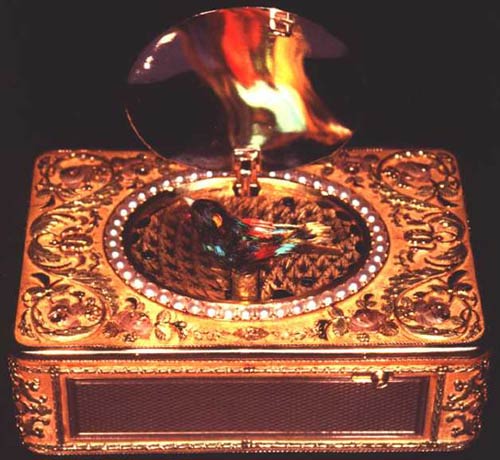
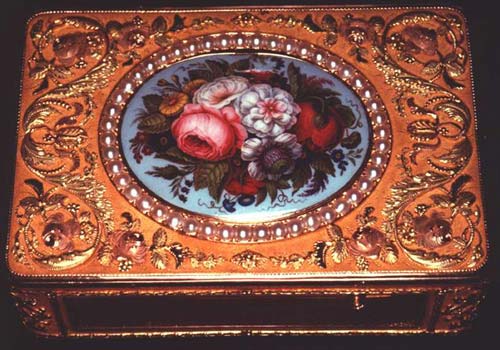
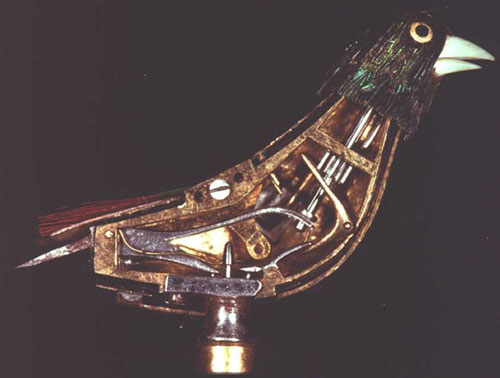
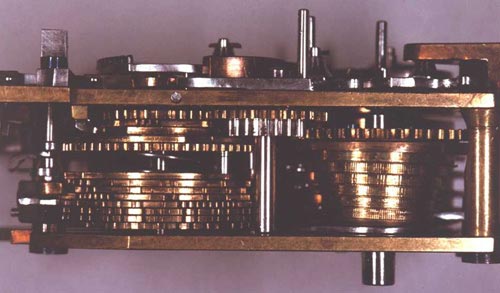
This page contains photographs of devices known as automata (or if you prefer, automatons.) Automaton (singular) is defined as: “A mechanism having its motive power so concealed that it appears to move spontaneously.” The term is generally applied to mechanical human or animal figures which move by clockwork motivation. These figures, the swan, soldier clock, bird box, and Cox carousel clock, and above all, the Jack figures, Southwold Jack and Jack-o-the-Clock, are all automatons.
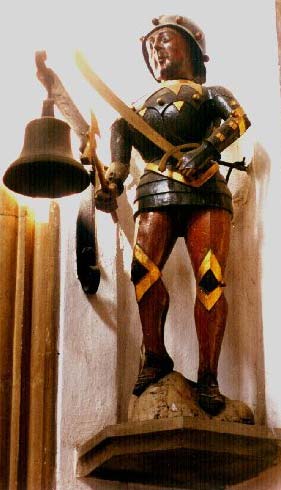
Left: The clock-jack, or jaquemart, is a mechanical human figure who strikes the time on a bell. This particular figure is named Jack the Smiter. He resides in the Southwold parish church in Suffolk, England, in a niche near the choir. He stands 4 feet 4 inches tall, is constructed of painted wood, and strikes the hours on a bell with his axe. C. F. C. Beeson notes that he once held a scimitar in his left hand, and that he is not presently operated by the original mechanism. He dates from approximately 1480. (Jack the Smiter is the Registered Trademark of THE BRITISH CLOCKMAKER,® INC.)
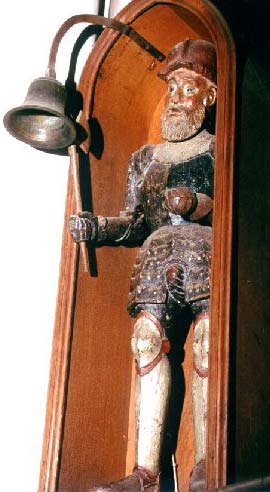
Right: Residing in the nearby Blythburgh “Cathedral of the Marshes” is another Jack, this one known as Jack-o”-the-Clock. He dates from about 1680.Very few of these figures survive.
In their day they were either used as toys for the very rich, or were designed as Deus ex Machina to strike reverential fear into the hearts of simple peasant worshippers in church.
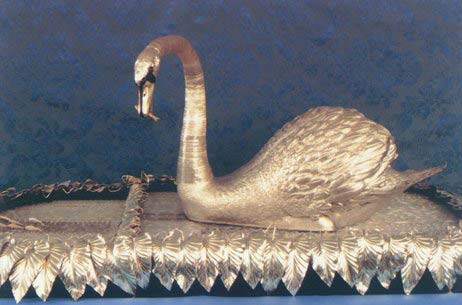
Left: One of the most ingenious automata in existence, this is the full size Silver Swan in the Josephine and John Bowes Museum in Barnard Castle, Co.Durham, UK. It is attributed to a collaboration by James Cox, the famous 18th century English clockmaker, and Joseph Merlin, an inventor and entrepeneur. (Photo courtesy, The Bowes Museum)
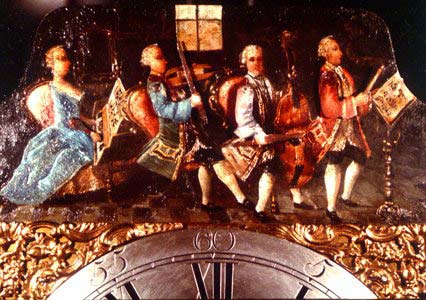
Right: Automated musicians above the dial play in unison with an 18th century English musical bracket clock.
The more familiar and simple cuckoo clock is a primitive example of an automaton in which a carved wooden bird appears on the hour to announce the time.
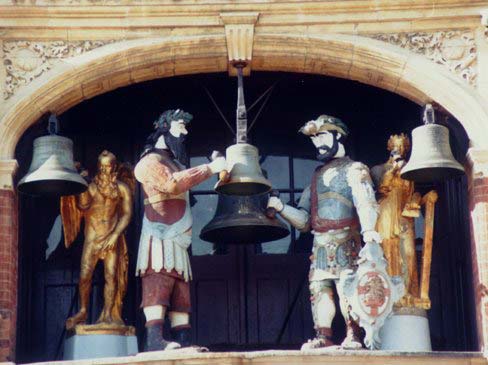
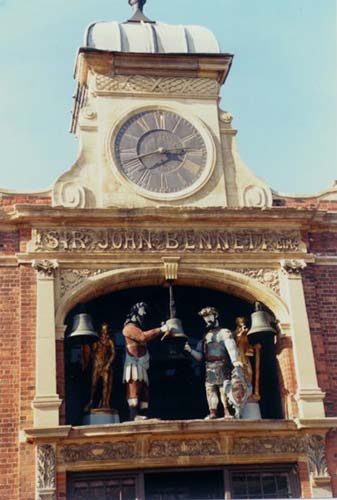
Left and Center: Gog and Magog were two automata who performed in a public display on the facade of a London Jewellers, Sir John Bennett, Ltd. When the building was about to be pulled down, Henry Ford acquired it, the clock, and the automaton display and had them shipped to his “Greenfield Village” in Dearborn, Michigan where he had them installed. Gog and Magog perform along with other animated figures, ringing bells and cavorting as they did for many years before in London. (Photos credit: Rollande Krandall)
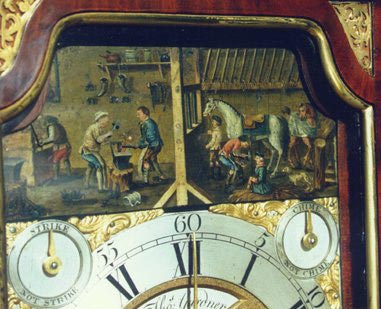
Right: The blacksmith hammers the horseshoe while the farrier shoes the horse.
There were also watches which depicted sexual activity, the “porno stars” of the day performing to the accompaniment of mechanical music whose motive power was the same clockworks that provided their libido! Precursors of computer generated activity and explicit videos?
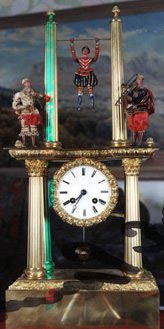
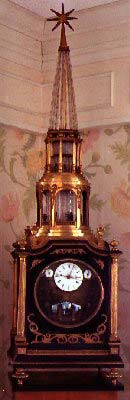
Left: An acrobat automaton performs, activated by the French clock. Used by permission.
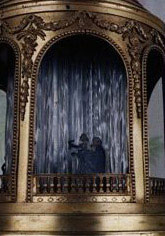
Center photos: Another James Cox creation: A waterfall simulated by rotating glass rods contains two figures who appear to walk through it. Photo Credit: Steve Callihan, FBHI.
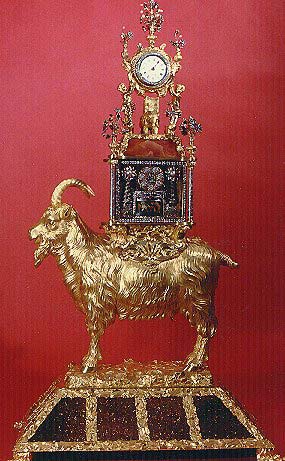
Right: English 18th century musical automaton clock by James Cox.
More automata information can be seen at the Delightful Machines web site where you will find information on further reading and other resource material.
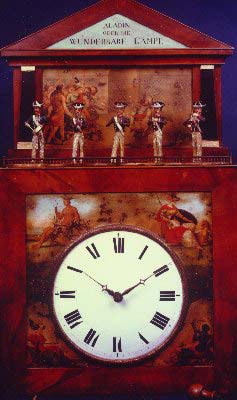
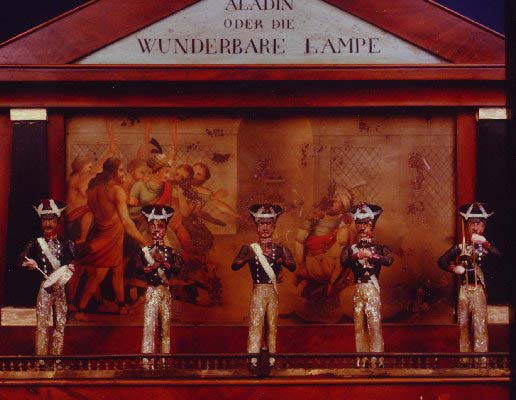
Right: German soldier clock, playing eight tunes on 36 wooden flutes.
Left: Detail of soldier clock; soldiers rotate and raise their instruments.
We are always interested in learning of other examples of automated figures or mechanisms in any form, and would be grateful for photographs, descriptions or links to other relevant sites.